
Design & visuals
Star of the South has been developed over several years in response to technical, environmental, stakeholder, regulatory and supply chain considerations.
Design refinement will continue through a ‘detailed design’ phase over the coming years – ensuring a feasible, effective and responsible project that delivers for our energy system, communities and environment.
What will I see?
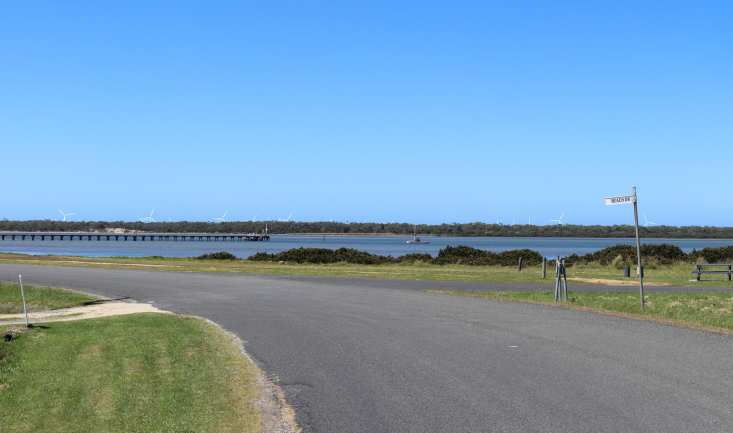
At 10-40 km from shore, Star of the South will be visible from some locations along the Gippsland coast. Views will vary depending on the location, distance, weather conditions and time of day.
Interactive map
Explore the project and experience views from different locations under various weather conditions. To see this on a big screen and discuss what you’re seeing with us, drop into our Gippsland office.
Technical photomontages
A series of technical photomontages have been prepared for Star of the South’s environmental assessment. These images are real real photos with project infrastructure added digitally. They provide a technically accurate representation of the project’s scale and visibility.
Wind farm layout
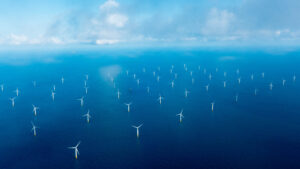
The wind farm layout will continue to be optimised to ensure it generates as much electricity as possible, balancing environmental protection, safety and coexistence.
Siting turbines, cables and offshore substations is a detailed technical process guided by extensive environmental studies, engineering assessments and stakeholder input.
When designing the layout, we consider:
- Wind resource and energy performance
- Seabed conditions
- Environmental values and sensitive marine features
- Navigation, safety and maritime regulations
- Commercial and recreational fishing activity
- Existing infrastructure
- Future energy needs.
Key design features:
- At least 10 km from shore – The closest turbine will be a minimum of 10 km offshore, increased from 7 km in response to community feedback, with the furthest turbines up to 40 km away.
- Turbine spacing of at least 1 km – Plenty of space between turbines supports safe vessel transit and continued access for fishing and other marine activities
- Avoidance of sensitive habitat – Infrastructure will be positioned to avoid important marine habitats, such as high profile reefs, to protect ecological values
- Ongoing consultation – A final layout will be refined during detailed design in consultation with regulators and stakeholders.
Turbine design
Star of the South includes up to 147 turbines to harness the wind’s energy and generate electricity.
Offshore wind technology is continuing to advance. As turbines become more powerful and efficient, fewer are needed to generate more electricity.
The final turbine model for Star of the South will be selected through a competitive procurement process once all studies and assessments are complete and regulatory requirements confirmed.
Key design features:
- Up to 147 smaller turbines or fewer larger turbines – Reduced from 200 due to advancements in turbine technology
- Tip height of 271-350 m – Capturing strong and steady winds high above the sea’s surface
- 35 m clearance above water – Increased from 25 m in response to environmental data, to provide a safe zone for seabirds to fly and forage
- Designed to minimise visual impact – Turbine towers, blades and nacelles are painted light grey to reduce visual contrast and blend with the horizon and cloudy skies
- Safety lighting – Marine navigation and aviation safety lighting will be installed according to safety regulations.
Foundation design
Each turbine will be supported by a monopile foundation fixed securely in the seabed.
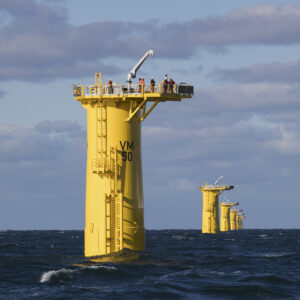
A monopile is a large steel tube driven into the seabed, with a yellow transition piece installed on top. The transition piece connects the foundation to the turbine tower and provides safe access for maintenance crews.
Monopiles are the most most common foundation type used in offshore wind projects globally. They provide a strong and proven solution and are ideally suited for the seabed conditions and water depths in Bass Strait.
Key design features:
- Monopiles up to 11.8 m in diameter or less if smaller turbines are used
- Installed up to 42 m below the seabed – Providing a secure and stable footing for the turbines
- Scour protection – Materials such as rock may be placed around the base of each foundation to protect them from scour and seabed erosion
- Marine life protection during installation – The best available technologies and management measures will be used to reduce underwater noise and protect marine life during construction.
Transition piece
Transmission design
Star of the South includes a transmission system to collect and transmit electricity from turbines to the grid.
This system has been designed to minimise environmental impact, reduce disruption for landholders and ensure a reliable connection to Victoria’s electricity network.
The exact route and infrastructure required will depend on the project’s final capacity, further site investigations, detailed design, ongoing consultation and approval requirements.
Key design features offshore:
- Inter-array cables – Lower voltage (66 kV) subsea cables connect turbines to an offshore substation
- Up to 5 offshore substations – Collect electricity and step up the voltage for transmission to shore
- Export cables – High voltage (up to 275 kV) subsea cables carry electricity from the substations to shore
- Buried in the seabed – Cables will be buried at a target depth of 1 m for export cables and 0.6 m for inter-array cables.

Key design features onshore:
- Approximately 30 km route – From Reeves Beach to Giffard, connecting into a proposed VicGrid hub
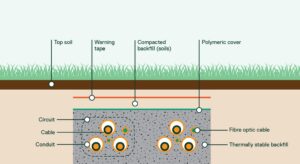
- Underground cables – High voltage (up to 275 kV) cables will be buried around 1 m deep
- Farming can continue – Following construction, land is reinstated and returned to its previous use, with most farming activities able to continue within the 40 m operational easement.
A cross section of the onshore cable system is shown below.